01 / FOR FURTHER REFINING
Black mass
A powder containing electrode materials, whose composition depends on the battery chemistry. Intended for downstream refining.
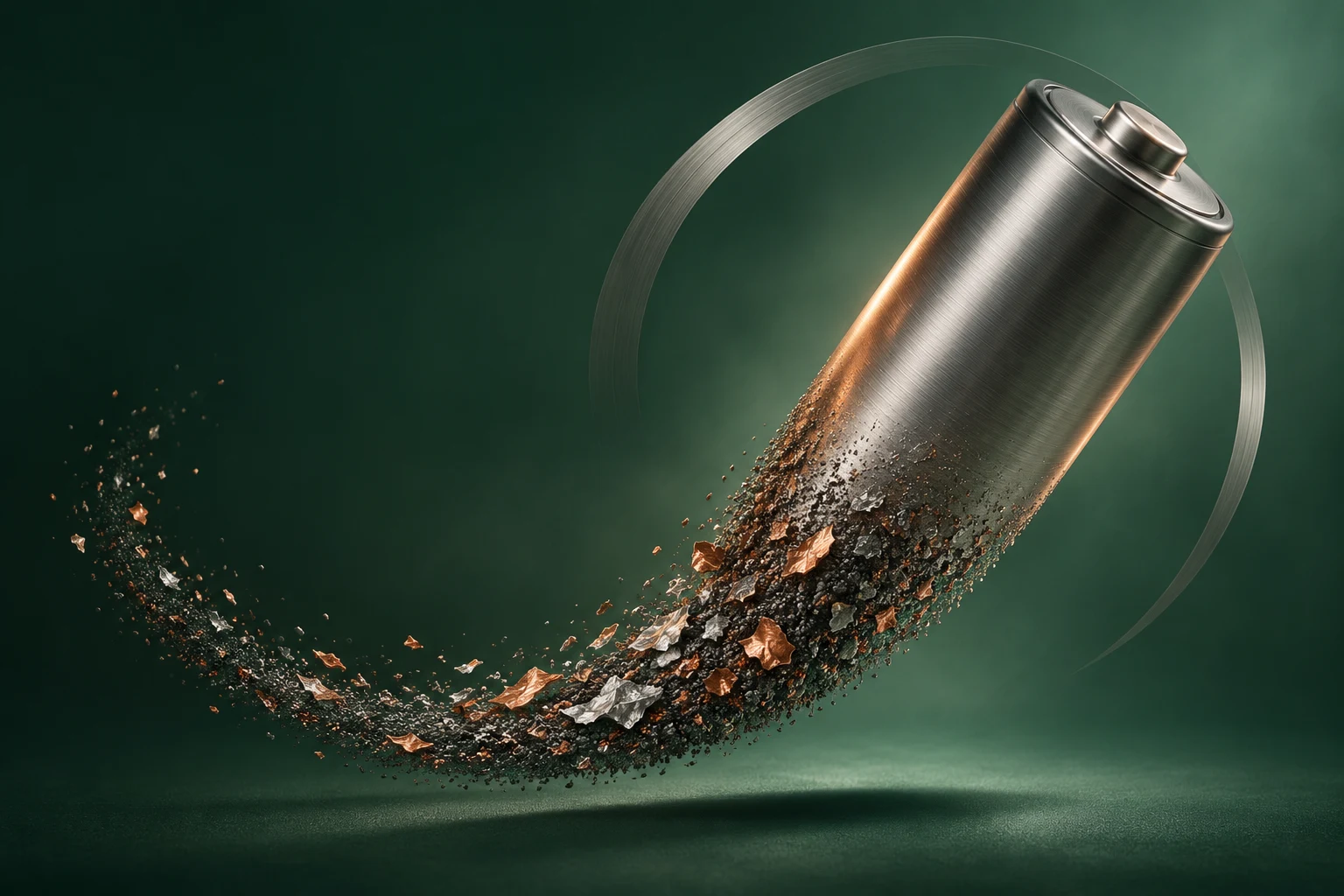
CIRCULAR BATTERY MATERIALS · MOROCCO
Building a local future for lithium-ion battery recycling. Turning end-of-life batteries into resources for tomorrow's industry.
A vision for circular materials · Concept illustration
THE OPPORTUNITY
Electric mobility and energy storage are changing how we power our lives. G-ReLiB is working to make battery recycling part of that transition in Morocco.
Our ambition: connect battery waste holders with a local recycling value chain, and return useful materials to industry.
OUR APPROACH
An industrial launch focused on material separation, with a research pathway toward more sustainable metal recovery.
INDUSTRIAL PROJECT · IN DEVELOPMENT
Our first commercial goal is to establish a recycling line that separates black mass, copper and aluminum from spent lithium-ion batteries.
Industrial operations are being prepared. Site selection, required authorizations and commissioning remain part of the launch process.
Develop supply relationships and identify suitable battery streams.
Plan controlled discharge and dismantling with qualified personnel.
Use shredding, crushing and sorting to separate material fractions.
Prepare recovered fractions for suitable downstream processors.
RESEARCH & DEVELOPMENT
Our second phase investigates selective metal recovery from black mass using plant-derived ligands and deep eutectic solvents.
This technology is under development. Commercial performance and environmental benefits remain to be validated.
Characterize black mass and the metals it contains.
Investigate bio-based ligands and alternative solvent systems.
Study selectivity and recovery performance at laboratory scale.
Assess technical feasibility and environmental performance.
MATERIALS WITH A FUTURE
The planned mechanical recycling stage targets three valuable material streams.
01 / FOR FURTHER REFINING
A powder containing electrode materials, whose composition depends on the battery chemistry. Intended for downstream refining.
02 / RECOVERED METAL
A metal fraction separated during processing, with potential for reuse through established metal recycling routes.
03 / RECOVERED METAL
Another recoverable metal fraction, creating value alongside black mass and copper.
Composition, purity and volumes will depend on feedstock and validated process performance.
WHO WE WANT TO WORK WITH
EV distributors, workshops and fleet operators with retired or defective lithium-ion battery packs.
Operators and infrastructure providers managing lithium-ion backup batteries.
Solar and storage providers handling retired systems, defective modules and released warranty returns.
SCIENCE AT THE CORE
Our research brings materials science and green chemistry together to explore selective recovery of strategic metals from black mass.
Plant-derived ligands and deep eutectic solvents are at the heart of this research. The goal is to develop a technically viable route with a better environmental profile.
Research stage · Laboratory validation in progress
Target metals vary with battery chemistry.
THE PEOPLE BEHIND G-ReLiB
G-ReLiB is led by Dr. Hajar El Ouahabi and is developing within the UM6P Launchpad program.

Founder & project lead
Materials science, electrochemistry and battery recycling.

Environmental engineer
Environmental engineering within the project team.
Expert adviser
Scientific and technical support in an advisory capacity.
GOOD TO KNOW
G-ReLiB is preparing its industrial launch. Site selection, authorization procedures and commissioning are part of the development process. Contact us to discuss future partnerships and timing.
Our project focuses on lithium-ion batteries, particularly NMC and LFP, from mobility, telecommunications and stationary storage. Each potential battery stream needs to be assessed before any collection arrangement.
Black mass is a powder obtained during battery processing that contains electrode materials. Its composition varies by battery chemistry and it can be further processed to recover useful materials.
We welcome discussions with battery waste holders, material buyers, industrial partners, research teams and investors. Tell us about your organization and the collaboration you have in mind.
LET'S BUILD WHAT COMES NEXT
Have a battery stream, a research idea or an industrial partnership in mind? Start a conversation with G-ReLiB.
Open your email app to send it, or copy the message and email us directly.